Minor Subjects
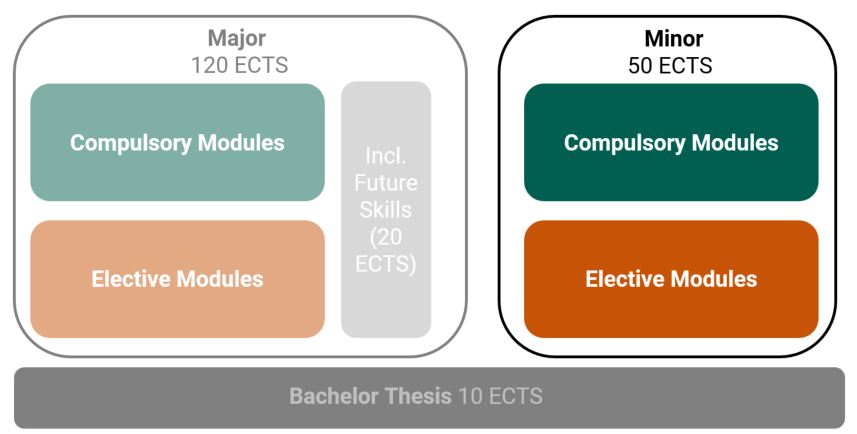
There are 16 minors to choose from:
The minor in Anglophone Area Studies is offered by the English Department of the Faculty of Humanities of the Chemnitz University of Technology.
The minor subject ‘Anglophone Area Studies’ is a social science-oriented, English-language programme – unique in Germany – which focuses on the history, society, culture and politics of various English-speaking countries. This minor subject covers historical, geographical and ethnological approaches to research, but above all sociological and political science approaches. In addition to the core countries of study – the United Kingdom and the United States of America – other former colonies such as Canada, Australia, India, Nigeria and South Africa are also included in the curriculum.
With this focus – which is broad on the one hand yet can be tailored to individual interests on the other – the Anglophone Area Studies minor can complement a wide range of different main subjects. For many subjects from other faculties, as well as for the more humanities-oriented subjects within the Faculty of Arts, this minor enables students to acquire entirely different, additional qualifications and can thus also open up further career prospects. For more closely related subjects such as History, Sociology, European Studies or Political Science, combining them with Anglophone Area Studies can deepen the knowledge and skills gained from the main subject in a very specific area, thereby offering the opportunity to develop a distinctive academic and professional profile.
The minor in Non-formal Education in Childhood and Adolescence is offered by the Institute of Education of the Faculty of Humanities of the Chemnitz University of Technology.
This minor subject, taken alongside a non-educational major, provides a fundamental academic and practice-oriented grounding in knowledge and skills relating to target-group-specific, institutional and structural frameworks, as well as the theoretical, methodological and practice-specific foundations of educational work in the fields of extracurricular education for children and young people. The aim is to meaningfully expand the skills acquired in the main subject with essential knowledge of educational science and practice-relevant pedagogical skills, so that graduates can embark on a career in educational work with children and young people, e.g. in
- educational and career guidance
- childcare and upbringing
- out-of-school education for children and young people and vocational support for young people
- social counselling and social work
- political education or education for democracy
- learning support and guidance
but also in non-educational fields of activity involving educational tasks, e.g. in
- work relating to education
- family and social policy
- media reception and media work by and with children and young people
- editorial, journalistic or proofreading work on topics relating to education
- upbringing and socialisation
- staff and/or organisational development
Great importance is attached, within the minor subject, to the study of heterogeneity and social difference in educational contexts, as well as to the necessary creation of inclusive, equitable and democratic conditions for teaching, learning and participation for children and young people.
In conjunction with the relevant main subject, this minor subject leads to an initial professionally qualifying degree and, in addition to the career paths and fields of work already mentioned – depending on the specific requirements – opens up the possibility of progressing to a Master’s programme. In doing so, the specific entry requirements of the respective Master’s programmes must be taken into account.
You can find further information about the minor subject on this website.
The minor in Critical Media Design is offered by the Institute for Media Research of the Faculty of Humanities of the Chemnitz University of Technology.
The minor subject in Critical Media Design provides a sound understanding of how analogue, digital and technical media can be understood and designed as spaces for communication and interaction. The focus is on the conception, prototyping and evaluation of digital media offerings and socio-technical systems, particularly in the contexts of human-computer interaction, digitalised learning, and platform and communication design. The programme follows a user-centred approach and combines academic rigour with creative and development-oriented work.
In terms of content, the minor subject covers areas such as human-technology systems, learning and learning with media, visual sociology, image data analysis and instructional design. In addition, there are specialisations in areas such as media aesthetics, accessibility of digital media, multimedia and interactive learning media, social media and visual media cultures. Students learn to identify user requirements and interaction dynamics, translate these into communication and design concepts, and develop and test digital applications through iterative processes.
In their professional practice, graduates can use this knowledge to conceive, design and evaluate digital media offerings, learning environments, platforms and interactive applications. Areas of application include the media and creative industries, product and concept development, the field of user experience (UX), instructional and communication design, as well as media and project management in business, education, culture and academia.
You can find further information about the minor subject on this website.
The minor in Digital Humanities and Cultural Semiotics is offered by the Institute for German Studies and Intercultural Communication of the Faculty of Humanities of the Chemnitz University of Technology.
Anyone who wants to understand culture today needs both: a keen eye for signs, images and meanings, and an understanding of how digital tools are changing the way we engage with language, media and knowledge. This is precisely where the minor in Digital Humanities and Cultural Semiotics comes in.
The minor brings together two dynamic fields: Cultural semiotics examines how people use signs – from language and gestures to images, videos and digital interfaces – to generate meaning, shape culture and negotiate identities. Classical models of signs and communication are combined with contemporary approaches to multimodal media and interaction analysis, and applied to phenomena ranging from everyday communication through literature, traditional media and film to social media.
The Digital Humanities explore such phenomena using computer-based methods. They enable the analysis of large text and media corpora, data visualisation, the development of digital editions and exhibitions, digital publishing, and the methodologically critical use of AI systems such as chatbots, large language models (LLMs) or computer vision. Further topics include research data management, digital knowledge cultures, open licences and ethical reflection on algorithm-driven culture. Theoretical discussion and practical project work are consistently interwoven throughout the programme.
Graduates thus acquire a skill set that is in demand in many forward-looking professional fields: in publishing and science communication, in museums, archives and libraries, in market, media and design research, in UX research, content strategy and AI-supported data analysis, in digital edition projects, in cultural journalism, and, last but not least, in research and teaching at universities and cultural institutions. The minor subject therefore provides an ideal complement to any of the major subjects. It is suitable for anyone wishing to deepen both their capacity for cultural reflection and their technical understanding in equal measure.
You can find further information about the minor subject on this website.
The minor in English Linguistics is offered by the English Department of the Faculty of Humanities of the Chemnitz University of Technology.
The minor in English Linguistics offers a specialisation in the field of digital linguistics. Students acquire skills in the areas of linguistic structure analysis, computational linguistics and digital communication, which are becoming increasingly relevant, particularly in the context of new technologies and AI-based language processing. Through practical language study, students acquire sound communicative skills and achieve a near-native level of English (C1–C2) – in the areas of pronunciation (including practical transcription exercises), grammar (to deepen their understanding of syntax) and reading (to improve their ability to read academic texts), which are particularly relevant to linguistics. This provides graduates with a broad base for the international labour market and qualifies them for a wide range of professional roles in academia, the media, culture or business.
The minor in English Literatures and Cultures is offered by the English Department of the Faculty of Humanities of the Chemnitz University of Technology.
A particular focus of the English Literatures and Cultures programme at Chemnitz University of Technology is its postcolonial orientation, which enables students to analyse literary works within the context of global power relations, including with regard to gender, postcolonial identity discourses, processes of hybridisation and cultural exchange. Through the integration of interdisciplinary approaches, the programme examines not only aesthetic and postcolonial aspects of literature but also its urban and media dimensions, providing students with a profound understanding of the diverse forms of expression found in English-language literature within English-speaking cultures.
In addition to theoretical knowledge, students acquire professional skills such as academic writing, presentation techniques and intercultural communication skills. Through this broad yet individually tailored programme, the minor in English Literatures and Cultures offers a wide range of career prospects in academia, culture, the media, and cultural and international organisations.
The minor in English Studies is offered by the English Department of the Faculty of Humanities of the Chemnitz University of Technology.
The minor subject of English Studies comprises three sub-disciplines: literature, linguistics and Anglophone Area Studies. English Studies analyses and reflects on the use of the English language as a lingua franca within the context of its metalinguistic, cultural, historical and political implications in the target cultures or cultures where English is used as a second language. The aim is to develop and impart linguistic-communicative, literary, cultural, historical and social foundations, taking into account their interdependence and diversity, as a prerequisite for successful international communication and cooperation.
The minor subject in English Studies thus offers a fundamental education in the humanities and social sciences with a practical focus appropriate to the subject. The innovative combination of academic reflection, interdisciplinary approaches and career-preparatory elements within the major subject (Future Skills) enables students to gain a comprehensive academic qualification and, in conjunction with a major subject, prepares them optimally for a globalised world of work.
The minor in Adult and Further Education is offered by the Institute of Education of the Faculty of Humanities of the Chemnitz University of Technology.
When combined with a non-educational main subject, this minor subject enables students to gain the qualifications required for a career in the diverse contexts of general and specialised adult and continuing education.
The programme focuses on imparting and developing the skills required to design educational programmes tailored to specific needs and requirements, and to identify and structure teaching and learning processes appropriate for adults. To this end, the programme imparts action-oriented specialist knowledge on theoretical and conceptual, institutional and structural, and field-of-action/target-group-specific topics and subject areas within vocational and general adult and continuing education; students are comprehensively prepared for their future professional practice through varied, practice-oriented assessment formats, direct links to real-world applications and fieldwork. The chosen major subject ensures the necessary specialist expertise for specific roles and fields of work.
The programme’s balanced structure in terms of subject matter and methodology, combined with opportunities for individual specialisation, opens up a wide range of pathways to future career profiles, e.g. in the following areas:
- the development, delivery and evaluation of adult education programmes
- learning support, monitoring of learning outcomes and ensuring knowledge transfer
- advice on further education
- identification of training needs and the organisation and evaluation of programmes (education management)
This opens up opportunities for use, for example, in publicly funded or privately run venues and organisations
- general, cultural and political adult education (e.g. adult education centres)
- vocational and in-company training and further education (companies/organisations)
- non-formal education (museums, associations, clubs, etc.)
The aim is to provide future graduates with the appropriate foundations for either an individual career start or for further academic study in the form of a Master’s degree, whilst taking into account the diversity of the field.
You can find further information about the minor subject on this website.
The minor in European Studies is offered by the Institute for European Studies and History of the Faculty of Humanities of the Chemnitz University of Technology.
As part of this minor, students are introduced to various aspects of European studies. The minor focuses on the disciplinary perspectives represented at the Institute for European Studies and History (geography, political science, sociology, cultural studies, history and law), which in turn revolve around ‘Europe’ as a subject of teaching and research. ‘Europe’ is to be understood in a broad sense and is not limited solely to the European Union, although the latter naturally plays an important role in the curriculum. During the core and advanced stages of their studies, students can choose between modules and thus independently determine the focus of their studies.
The minor in German Studies is offered by the Institut for German Studies and Intercultural Communication of the Faculty of Humanities of the Chemnitz University of Technology.
Anyone with a passion for language, literature and communication who wishes to complement their non-German studies major with key humanities skills will find a broad introduction to the subject here. Unlike specialised programmes, this minor at Chemnitz provides an introduction to all four sub-disciplines of German studies.
Modern German and Comparative Literature provides a grounding in German-language literature from the 17th century to the present day, supplemented by an introduction to intercultural and media-theoretical issues. The History of German Literature and Language in the Middle Ages and Early Modern Period offers initial insights into historical stages of language development, as well as into literary forms of expression from earlier eras and their cultural contexts. German Linguistics, Semiotics and Multimodal Communication teaches fundamental models for describing language and demonstrates how communication across different media – from the spoken word to images and text – can be analysed. In the area of German as a Foreign and Second Language, students are introduced to key aspects of language acquisition, language teaching and multilingualism.
Students thus acquire a broad foundation of knowledge which, in combination with their major subject, enables them to develop interdisciplinary skills (language analysis, language teaching, etc.). Depending on their major subject, career opportunities are available in publishing houses, editorial offices and media organisations; in PR, advertising and corporate communications; in museums, theatres and other cultural institutions; in adult and continuing education; in the field of German as a foreign language; in cultural management; and in research and academia.
You can find further information about the minor subject on this website.
The minor in Computer Science is offered by the Faculty of Computer Science of the Chemnitz University of Technology.
In this degree programme, the minor in Computer Science is combined with a non-computer-science major. The basic idea is that, by acquiring selected key competences in computer science, Bachelor’s students can create individual synergies with the skills they have gained in their major. The focus is, on the one hand, on developing a general understanding; on the other hand, students can acquire more advanced computer science competences in a specific area of specialisation. For example, for a major in Educational Science, the specialisation ‘How Computers Work’ could be useful both for reasons relating to content and teaching methodology, whilst the specialisation ‘Programming’ could be beneficial for the development of educational software.
You can find further information about the minor subject on this website.
The minor in Media Use & Effects is offered by the Institute for Media Research of the Faculty of Humanities of the Chemnitz University of Technology.
The minor subject ‘Media Use & Effects’ provides a sound academic understanding of the role that media play in everyday private and professional life, in interpersonal relationships and in social developments. The focus is primarily on processes at the individual and group levels, such as the influence of media on well-being, learning outcomes and everyday communication. At the same time, the minor also addresses key phenomena at the macro-social level, such as the formation of public opinion, agenda setting, the emergence of mainstream culture and societal trends in media use. Throughout, the course centres on a reflective examination of the opportunities and risks associated with media.
In terms of content, the minor covers key areas such as strategic communication, health communication, entertainment psychology, social media, mobile communication, media and society, children and media, media literacy, visual media cultures, and multimedia and interactive learning media. This enables students to acquire in-depth knowledge of various communication contexts, media formats and socially relevant fields of application.
In their professional careers, graduates can use this knowledge to analyse, evaluate and help shape media offerings, communication processes and digital applications in a way that is tailored to specific target groups. Areas of employment include media and communication professions, research and consultancy, the education sector, and the development and evaluation of digital offerings.
You can find further information about the minor subject on this website.
The minor in Medieval Studies is offered by the Institute for German Studies and Intercultural Communication and the Institute of European Studies and History of the Faculty of Humanities of the Chemnitz University of Technology.
Anyone interested in pre-modern literature, culture and history, and wishing to trace their influence right up to the present day, will find a tailored and varied range of degree programmes at the Chemnitz University of Technology. The minor subject is linked to the chair of the History of German Literature and Language in the Middle Ages and the Early Modern Period and the chair of the History of Europe in the Middle Ages and the early modern period.
The Chemnitz programme is characterised by the close integration of history and literary studies, with a particular focus on the reception of the Middle Ages and the Early Modern Period. Students acquire fundamental skills in the analysis of medieval texts and sources, whilst at the same time sharpening their perspective on the present day – for example, through a critical examination of modern ‘images of the Middle Ages’.
The minor subject combines core modules (foundations), specialisation modules (subject-specific specialisation) and supplementary modules (individual focus, research-related topics, excursions). The interdisciplinary programme strengthens textual and analytical skills, critical thinking and the ability to communicate complex content clearly. Innovative assessment formats such as project work, portfolios, presentations and science slams encourage the practical and creative application of skills.
The qualifications gained open up a wide range of career prospects, particularly in the media and publishing industries, editorial work, public relations, museums, archives, libraries, as well as in communications consultancy and education. Graduates are particularly well-equipped to analyse and communicate cultural contexts and to apply them to current issues.
You can find further information about the minor subject on this website.
The minor in Political Science is offered by the Institute of Political Science of the Faculty of Humanities of the Chemnitz University of Technology.
The programme at the Institute of Political Science is characterised by a close relationship between students and lecturers and a high level of personal support within small study groups. Despite the Institute’s manageable size, all core areas of a basic curriculum in political science, in accordance with the recommendations of the German Political Science Association (DVPW), are comprehensively covered by the Institute’s academic staff. The main feature of the minor is that the individual modules are coordinated not only in terms of content but also in terms of methodology, in order to enable students to make optimal progress in their studies.
The minor in Sociology is offered by the Institute of Sociology of the Chemnitz Unviersity of Technology.
In the Sociology minor, students explore key issues relating to society, social coexistence and current social developments. To begin with, students are introduced to the most important concepts and theories in General Sociology, which can be used to explain social structures and changes. Building on this foundation, they explore various subject areas in greater depth, such as the sociology of work and organisations, the sociology of technology or the sociology of health. The focus is on specific areas of social life – such as work, digitalisation or health – and the social processes at work within them.
Empirical social research is a key component of the programme. Students acquire knowledge of how data is collected, analysed and interpreted – using both qualitative and quantitative methods. This enables them to carry out their own small-scale research projects, as well as to critically examine studies and evaluate findings in an informed manner.
In addition, students gain insights into political and social contexts. In political sociology, for example, topics such as power, political decision-making processes and social conflicts are addressed – in other words, subjects that are closely linked to current public debates.
Overall, the minor subject combines theoretical foundations, practical application and current topics. Students learn to analyse social developments in a nuanced way, to reflect on them critically and to examine them from different perspectives. At the same time, it becomes clear how closely academic findings are linked to real-world social issues.
You can find further information about the minor subject on this website.
The minor in Statistics is offered by the Faculty of Mathematics of the Chemnitz University of Technology.
The minor subject of Statistics is an interdisciplinary field of study that stands out for its application across a wide range of disciplines. At Chemnitz University of Technology, it is based within the Faculty of Mathematics. In an era of the AI revolution and a massive increase in data collection, the use of classical statistical models and modern machine learning methods is becoming increasingly important in the professional lives of graduates from all disciplines, including the humanities and social sciences.
The programme takes a broad approach and not only imparts fundamental and advanced knowledge of statistical methods, but also promotes the practical application of these techniques through programming in modern languages (such as R or Python). Students learn how to carry out statistical analyses and implement machine learning algorithms, or how to utilise existing software, in order to succeed in their professional careers.
The programme offers flexibility and a wider range of options, enabling students to tailor their curriculum to their individual needs. This flexibility combines the benefits of a broad education, as offered in traditional Master’s programmes, with the structured approaches of the Bachelor’s/Master’s system, including the accreditation of degree programmes.
You can find further information about the minor subject on this website.